
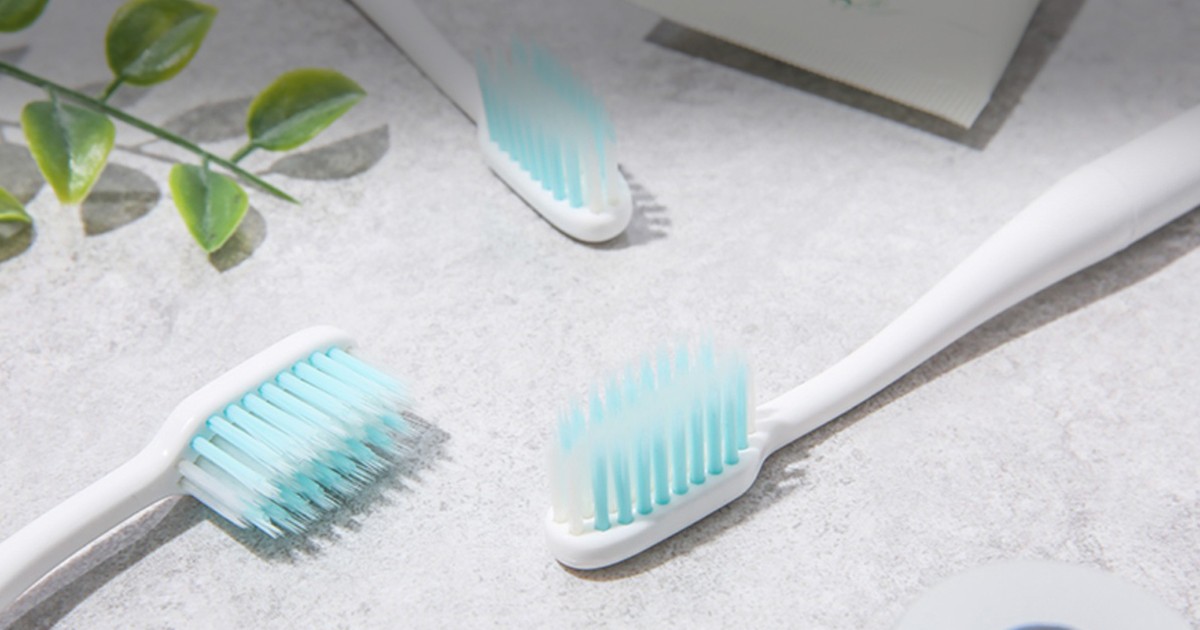
A brand owner briefing a manufacturer should specify toothbrush head design (head length and width, head shape, profile thickness and tuft area) and handle design (neck angle and length, handle shape, grip zones, grip material and thumb rest). Each choice should follow from one named target user, such as people with fixed braces, implant or sensitive-gum users, or clear aligner users.
What toothbrush head design variables can a brand owner specify?
The head is the part of the brush that carries the bristles, and a brand owner can set five main variables for it in a brief.
- Head length: the distance from the neck to the tip of the head. It sets how far the bristle field extends towards the back teeth when the brush is in the mouth.
- Head width: the distance across the head. It sets how much of a tooth surface the bristle field covers in one position.
- Head shape: the outline seen from above, for example rounded, tapered towards the tip, or rectangular. The tip shape decides how the front of the head meets the last teeth in each arch and the spaces around brackets or wires.
- Profile thickness: the height of the head body measured from the back of the head to the base of the bristles.
- Tuft area: the part of the head where bristle tufts are set, together with the layout of the tufts inside it. A tuft is a single bundle of bristles anchored in one hole of the head.
A brand owner can list all five head variables together in one section of the brief, so the manufacturer sees the full head specification in one place.
How do neck and handle design affect control and comfort in daily use?
The neck and handle decide how a user holds the brush and guides the head to each part of the mouth.
- Neck angle: the bend, if any, between the handle and the head.
- Neck length: the distance between the grip and the head. It sets how far the hand stays from the mouth while the head reaches the back teeth.
- Handle shape: the cross-section and outline of the handle, for example slim and round, flat, or contoured. The shape decides how the handle sits in the fingers and the palm.
- Grip zones and materials: the areas of the handle where the fingers rest, and the material chosen for those areas.
- Thumb rest: a shaped or textured area on the handle where the thumb sits. It gives the user a fixed reference point for holding the brush the same way each time.
How should head and handle design match each target segment?
Each target segment needs its own head and handle brief, built on a common baseline of soft bristles. According to the American Dental Association, the consensus recommendation is for people to “brush their teeth for two minutes twice a day with a toothbrush that has soft bristles.” A brand owner can treat soft bristles as the starting point for every segment below and then set the head and handle for each user group.
Fixed braces: compact heads
For a brush aimed at people wearing fixed orthodontic appliances, a brand owner can list a compact head in the brief, together with the head shape and the tuft layout around brackets and wires. SANGSI’s orthodontic toothbrush is designed for people wearing fixed orthodontic appliances.
Implant, post-surgical and sensitive-gum users: gentle and precise heads
For a brush aimed at people with sensitive gums or recovering from dental implant surgery, a brand owner can list a gentle, precise head in the brief, together with the handle grip and thumb rest. SANGSI’s implant and post-surgical care toothbrush is intended for people with sensitive gums or recovering from dental implant surgery.
Clear aligner users: wide heads
For a brush aimed at people who use clear aligners, a brand owner can list a wide head in the brief, with the head width, head shape and handle grip stated together. SANGSI’s wide-head toothbrush set is intended for people who use clear aligners.
A brand owner should keep each segment on its own product and its own pack. One brush should not be presented to several of these user groups at once.
How do head and handle choices interact with branding and packaging?
A brand owner can specify handle colours, logo placement, a pack window and on-pack segment information in the same brief as the head and handle.
- Handle colours: the colour or colour family chosen for the handle of each segment’s brush.
- Logo placement: the position of the logo on the handle, for example a flat area outside the grip zones and the thumb rest.
- Pack window: a clear window in the pack that shows the head, so a buyer can see the head shape and size before opening the pack.
- On-pack segment information: the pack should name the intended user in plain words, such as people wearing fixed braces, people with sensitive gums or recovering from implant surgery, or people using clear aligners. The pack wording should describe what the brush is designed for and stay within what the brand owner can support.
What head and handle points belong in a brief, and what should be checked in samples?
A brief should name the target user first and then list each head and handle variable, so the manufacturer can build a sample that matches one clear purpose. SANGSI Co., Ltd. is an oral care manufacturer based in South Korea, and SANGSI offers OEM and private label toothbrush manufacturing for brand owners and distributors.
Points to include in the brief:
- The target segment and how the brush will be presented to that user
- Head length, width, shape and profile thickness
- Tuft area, tuft layout and bristle softness
- Neck angle and neck length
- Handle shape, grip zones, grip material and thumb rest
- Handle colours, logo position and pack window requirements
Points to check in hand when reviewing samples:
- Reach: whether the head reaches the back teeth comfortably and, for the braces segment, sits around brackets and wires
- Grip: whether the handle stays secure in a wet hand and the thumb rest falls in a natural place
- Balance: whether the brush feels steady between the fingers, without the head or the handle end dragging the hand
- Comfort: how the bristles and the head edges feel in the mouth, and whether the product matches the intended user
Summary
Toothbrush head design covers head length, width, shape, profile thickness and tuft area, while handle design covers neck angle and length, handle shape, grip zones, grip material and thumb rest. A brand owner should start from soft bristles, match the head and handle to one target segment, specify colours, logo and pack information in the same brief, and check reach, grip, balance and comfort in hand before approving a sample.
