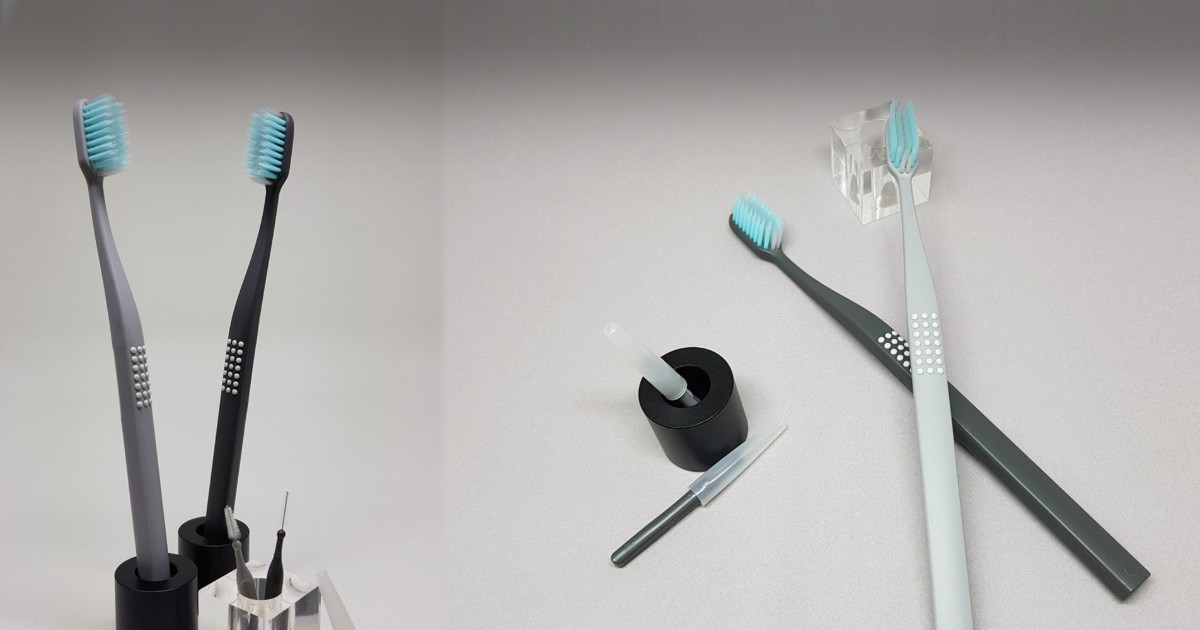
Any change between toothbrush orders that could alter how the brush feels, looks, fits or is labelled should require buyer notification and re-approval. This covers bristle filament, end-rounding and trim, tuft layout, handle materials, colorants, dimensions, molds, production lines and packaging. Toothbrush change control is the written agreement that tells the manufacturer which changes to report and which need the buyer’s sign-off against the signed reference sample before shipment.
What is the baseline for toothbrush change control after the first order?
The approved specification and the signed reference sample are the baseline for every repeat toothbrush order. The approved specification is the written description of materials, dimensions and packaging. The signed reference sample is a physical brush and pack that the buyer and manufacturer both signed as the standard.
Between orders, a manufacturer may switch a filament supplier, repair a mold, move production to another line or source a new carton. Toothbrush change control sets out how each of these steps is reported to the buyer and compared with the baseline before goods made with the change are shipped.
Which toothbrush product changes should require notification and re-approval?
A buyer should list every material and dimension in the toothbrush specification as a change that needs notification and re-approval. A practical list for a manual toothbrush includes:
- Bristle filament material or grade: the filament polymer, its grade and its supplier.
- End-rounding and trim profile: end-rounding is the process that smooths the cut tip of each filament; the trim profile is the shape of the bristle field once cut.
- Tuft layout: the number, position and angle of tufts in the head.
- Handle and grip materials: the base plastic and any soft-touch overmold on the grip.
- Colorants: a new colour masterbatch or pigment supplier, even for the same named colour.
- Head, neck or handle dimensions: length, width, thickness and angle of each part.
Brand owners who want a fuller checklist of the bristle parameters to put in the specification can use the guide on what brand owners should specify for toothbrush bristle design. Every item specified there is a candidate for the change-control list.
How should tooling and process changes be handled?
Tooling and process changes should be notified before production and confirmed with a first-off sample before the batch ships. A first-off sample is the first set of brushes produced after a change, taken from the production run itself rather than made by hand.
Tooling and process changes to list include:
- A new mold, a second mold cavity added for capacity, or a repaired or re-polished mold.
- A new tufting setup, including a changed tufting machine, tuft insertion method or anchoring setup.
- Moving the product to a different production line or a different factory site.
- A change in a process step such as trimming, end-rounding or printing on the handle.
When a first-off sample arrives, the buyer compares it side by side with the signed reference sample. Useful checks are:
- Head, neck and handle dimensions measured against the specification drawing.
- Bristle feel, trim shape and tuft layout, judged by hand and by eye next to the reference sample.
- Colour of handle and grip under the same lighting as the reference sample.
- Surface finish, mold lines and any visible marks on the handle.
- Fit of the brush in its pack and the position of any printed logo.
If the first-off sample matches, the buyer signs it, and it can be kept alongside the original reference sample as a record of the approved change.
Which packaging and labelling changes need buyer review?
Any change to pack materials, pack structure or on-pack information should be reviewed by the buyer before the new packaging is used.
Packaging and labelling changes to list include:
- Switching the pack material, for example from one plastic to another, from plastic to paperboard, or to a different blister or window film.
- Changing the pack structure, size or the number of components in the pack.
- Any edit to printed on-pack information: product name, intended user, directions, material statements, recycling marks, importer details and batch coding position.
- A new print supplier or a change in printing method.
For EU-bound ranges, two current points are relevant. According to Packaging Europe (2026), the EU Packaging and Packaging Waste Regulation has officially applied since 12 August. According to the European Commission, Directorate-General for Environment (2026), the Commission’s public consultation on bio-based plastics in packaging will remain open until 13 January 2027.
How should a buyer classify and record toothbrush changes?
A buyer should sort every possible change into two classes, notify only or notify and re-approve, and record each change in a change log tied to batch identification.
Notify only versus notify and re-approve
Notify only covers changes the buyer wants to know about but that do not alter the product or pack the customer receives, such as a new internal work instruction or an equivalent shipping carton supplier. Notify and re-approve covers every change to materials, dimensions, tooling, process, production location, pack materials and on-pack information, as listed above. If the manufacturer is unsure which class a change belongs to, the agreement should say it defaults to notify and re-approve.
Keeping a change log tied to batches
A change log is a shared record of every notified change. Each entry should include:
- The product and specification version affected.
- A description of the change and the reason for it.
- The class of change and the date the buyer was notified.
- The approval decision, who approved it and the reference to the signed first-off sample.
- The first batch or lot number made with the change.
Confirming the regulatory classification still holds
Each change entry should also record that the buyer has checked the product’s regulatory classification in each market. According to the Legal Information Institute, Cornell Law School (21 CFR 872.6855), the US FDA regulation for manual toothbrushes reads: “Class I (general controls). The device is exempt from the premarket notification procedures in subpart E of part 807 of this chapter”.
How do change-control terms differ for private label and custom OEM?
A buyer can write change-control terms separately for private label and for custom OEM development.
In private label, the buyer sells an existing manufacturer design under the buyer’s own brand. For private label, the change-control clause can list which changes to the existing design are notified and which need re-approval, together with the pack and on-pack information. SANGSI’s functional toothbrush range (orthodontic toothbrush for fixed appliances · implant and post-surgical care toothbrush · wide-head toothbrush set for clear aligners) can be supplied to distributors under the distributor’s own label (private label). Brand owners planning that kind of range can read more on building a specialty toothbrush line under your own label.
In custom OEM development, the product is built to the buyer’s brief. For custom OEM, the clause can cover the full specification, the tooling and the reference sample. The steps that lead to the first signed sample are covered in how toothbrush OEM development works from brief to sample.
SANGSI Co., Ltd. is an oral care manufacturer based in South Korea. SANGSI offers OEM and private label toothbrush manufacturing for brand owners and distributors.
What should a buyer agree in writing before repeat toothbrush orders?
Before repeat orders, a buyer should agree a written change-control clause with the manufacturer that covers scope, timing, evidence and records. A short checklist:
- The list of changes that are notify only and those that are notify and re-approve, with re-approval as the default.
- When notification must be given, stated as before the change is used in production.
- What evidence the manufacturer sends with a notification: description, reason, and first-off samples where relevant.
- Where the signed reference samples are kept and how many sets each side holds.
- The format of the shared change log and how batch or lot numbers are recorded.
- What happens to goods made with an unapproved change.
- Who confirms packaging and labelling against each target market’s rules before a pack change is approved.
Summary: toothbrush change control in brief
In toothbrush change control, the approved specification and the signed reference sample are the baseline. Brand owners should require notification and re-approval for changes to filament, end-rounding and trim, tuft layout, handle materials, colorants, dimensions, tooling, production line and packaging, and check each first-off sample against the reference sample. Every change belongs in a change log linked to batch numbers, with a check of the product’s classification in each market. Terms for private label and custom OEM can be written separately, and both should be agreed in writing before the next order.